


Time-weighted return is the standard for performance reporting. If you're like me, you kinda sorta remember how it works, but wouldn't mind a refresher. The main thing time-weighted return solves is removing the impact of investor cash flows in and out of a portfolio.
We can take things up a notch by calculating the after-tax time-weighted return, which accounts for all taxable events (interest, dividends, realized gains, harvested losses, etc.) in a portfolio over time while also removing the impact of investor cash flows.
At this point, you may be wondering whether the after-tax return includes only the taxable events or also assumes we sell everything. We can differentiate between pre-liquidation (just the taxable events) and post-liquidation (sell everything) after-tax returns.
Finally, you may ask yourself, "How did I get here?" and secretly wonder whether this has anything to do with tax alpha, whatever that means! It does. But to understand tax alpha, we first need to introduce the concept of a benchmark and add taxable events to it.
I built Après Tax to make all of these concepts intuitive.
I have big plans for Après Tax, but I needed a refresher on many of these concepts and figured a learning app was a fine place to start.
Give it a try...
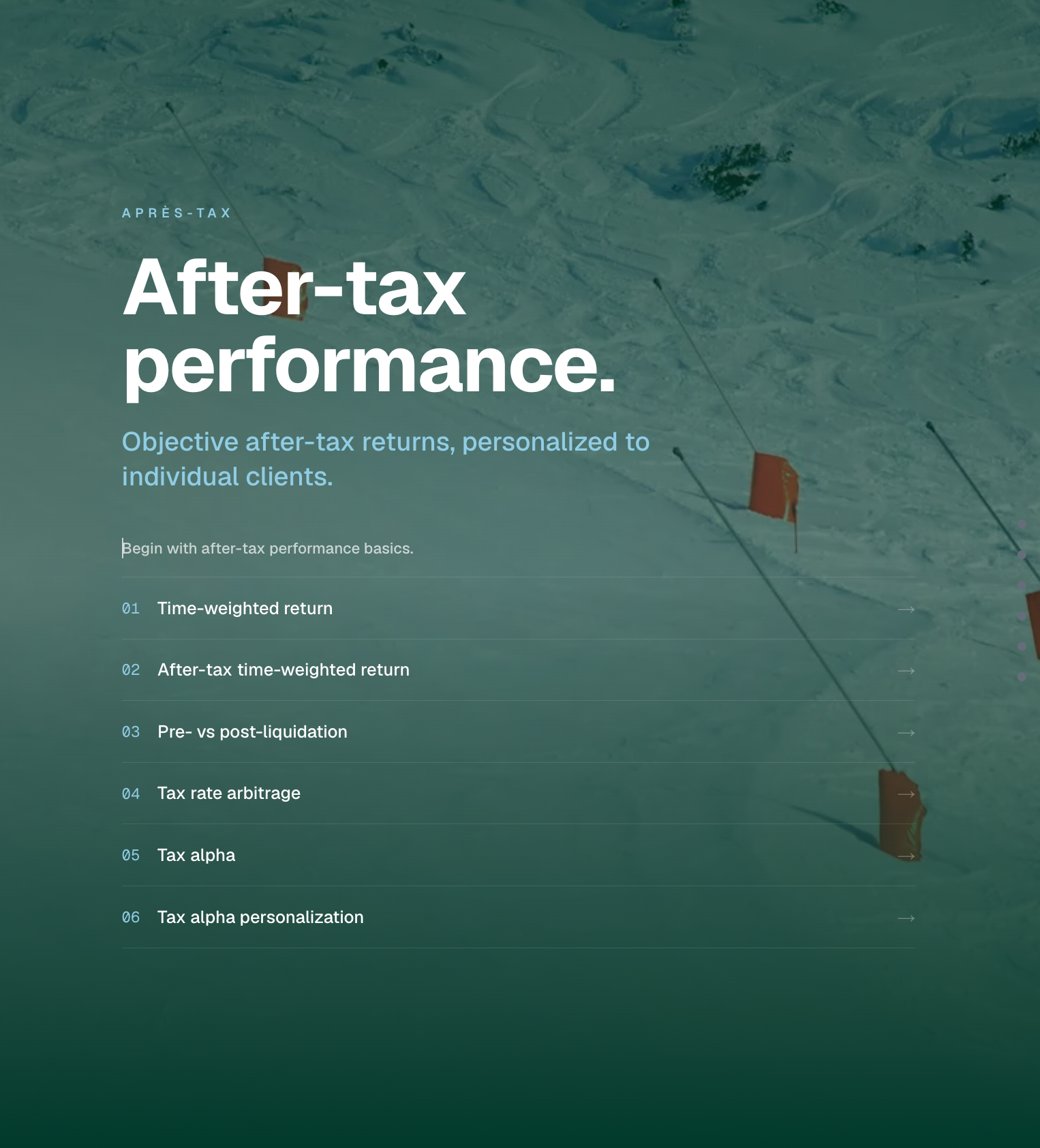
And example lesson in Après Tax

Happy Father's Day.